


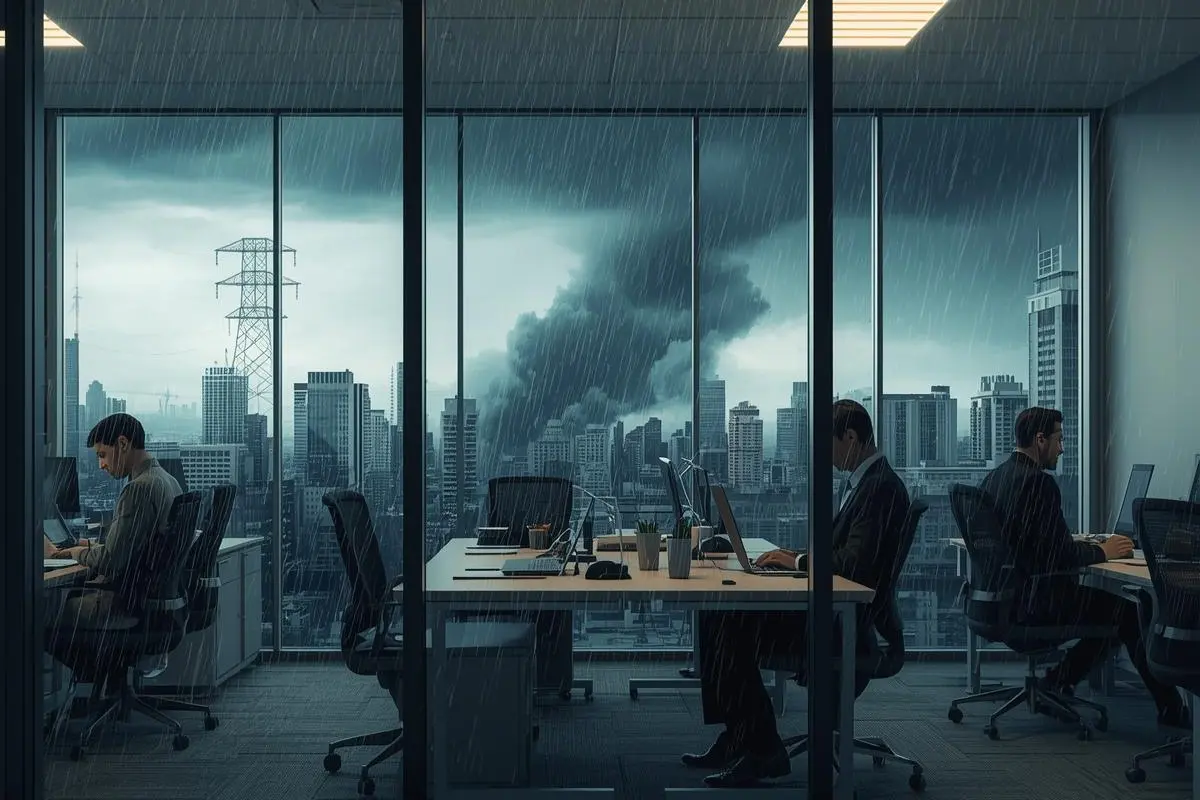
The heart of every New York business is its ability to open its doors and make money. If a fire, major storm, or other disaster forces you to close temporarily, Business Interruption Insurance (BII)—also called Business Income Insurance—can be a lifeline. This specialized coverage helps replace the income you lose and pays for ongoing bills while your shop, office, or facility is being repaired after a covered loss.
- Key Takeaways
- What exactly is Business Interruption Insurance, and how does it work?
- What Does BII Pay For?
- Who needs Business Interruption Insurance the most?
- The Alarming Statistics
- Businesses in New York That Especially Benefit:
- How does BII help New York businesses prepare for severe weather?
- Key Severe Weather Coverages:
- Frequently Asked Questions (FAQs) about Business Interruption Insurance
- Don't wait for disaster to find out you're not fully protected.
Key Takeaways
- BII is Your Financial Lifeline During Downtime: Business Interruption Insurance (BII) replaces the lost income (profit) your business would have earned and covers ongoing expenses (like rent and payroll) when physical damage forces you to temporarily close or slow down operations
- Physical Damage is Required to Trigger Coverage: BII is typically triggered only if the shutdown is caused by a “covered peril” that also damages your physical property, such as a fire, burst pipe, or wind damage (covered by your Commercial Property policy)
- The Risk is High Without It: Up to 90% of small businesses fail within two years after a disaster because they cannot recover quickly enough without financial support during the repair period. BII is crucial for surviving the immediate aftermath
- Watch the Waiting Period: Most BII policies have a 48- to 72-hour waiting period (time deductible) before coverage begins to pay out for lost income
- Customize for Local New York Risks: New York businesses should add endorsements like Civil Authority Coverage (covers income loss if authorities close access to your street due to a neighbor’s disaster) and Utility Service Interruption (covers income loss from off-premises power/water failure)
- Flood and Pandemic Are Typically Excluded: Standard BII generally does not cover income lost due to flood, earthquake, or pandemics/viruses because these events are not considered “physical damage” under the base policy. Special, separate policies or endorsements are needed for these risks
- Actionable Takeaway: Calculating the right limits for BII is complex—you must estimate future income and ongoing expenses. Partner with a specialist like MKR Specialty Insurance to customize your policy and ensure your limits are high enough to cover the entire period of restoration
What exactly is Business Interruption Insurance, and how does it work?
Business Interruption Insurance is a type of coverage that steps in when physical damage to your property forces you to pause or slow down your normal operations. It works to cushion the financial blow by replacing the income your business would have earned had the disaster not happened [^1.2].
The coverage is usually triggered only if the event causing the shutdown is a “covered peril”—meaning it’s something your regular Commercial Property Insurance pays for, such as a fire, burst pipe, theft, or wind damage.
What Does BII Pay For?
BII helps cover two main types of costs so you can focus on rebuilding:
- Lost Income: It replaces the net income (profit) you would have made during the time you are closed [^3.1].
- Ongoing Expenses: It covers necessary bills that continue even when your doors are shut, such as:
- Rent or Mortgage payments for your business space [^1.2].
- Employee Payroll for key workers, so you don’t lose them while you’re closed [^1.2].
- Loan Payments and Taxes that are still due [^1.2, 3.1].
- Relocation Costs if you have to move to a temporary spot to keep working [^1.2].
Hypothetical Example: A small bakery in Brooklyn suffers major damage from a kitchen fire. They must close for three months for repairs. BII pays the bakery owner the profit they lost during those three months and covers the rent and the wages for their head baker and manager until they can reopen.
Who needs Business Interruption Insurance the most?
Any small to medium-sized business that relies on a physical location to operate needs Business Interruption Insurance, especially those in New York where rents and operating costs are high [^1.5]. Businesses that run out of cash quickly after an emergency are the most vulnerable.
The Alarming Statistics
Without this coverage, a single disaster can be financially fatal. Consider these facts:
- The Federal Emergency Management Agency (FEMA) estimates that as many as 40% of small businesses never reopen after a natural disaster [^2.1].
- The Small Business Administration (SBA) estimates that closer to 90% of small businesses fail within two years after being struck by a disaster because they cannot recover quickly enough [^2.2, 2.5].
These numbers show that having Commercial Property Insurance to fix the damage is only half the battle. You need BII to handle the lost revenue while the repairs are underway, keeping your business alive until the doors can reopen.
Businesses in New York That Especially Benefit:
- Restaurants and Cafes: They rely entirely on daily sales and a physical kitchen.
- Retail Shops: If inventory and fixtures are destroyed, they need income replacement while ordering new stock.
- Manufacturing and Workshops: If specialized machinery breaks or the building is damaged, the shutdown time can be very long.
- Offices and Services: If the building is closed due to a fire or storm, even if they can work remotely, they may lose walk-in or local business.
How does BII help New York businesses prepare for severe weather?
New York faces unique threats, especially with severe winter storms, coastal flooding, and utility outages. BII is critical because the income loss from these events can last weeks or months [^4.4].
Key Severe Weather Coverages:
- Direct Damage: This is the most common trigger. If a severe winter storm causes the roof of your store to collapse, or high winds shatter all your front windows, BII pays for the lost income while the building is repaired [^3.3].
- Civil Authority Coverage: This is vital in New York’s densely populated areas. If a fire or a flood happens next door to your business, and the police or government shuts down access to your block or street for safety reasons, this coverage pays your lost income even though your property was not directly damaged [^1.2, 3.1]. This is common after severe storms or major utility failures [^4.4].
- Utility Service Interruption (Extension): Standard BII does not cover power outages unless they are caused by damage to your property. However, you can add an extension (endorsement) that covers income lost when an off-premises utility (like a power company’s generating station or water line) is damaged by a covered event, leading to an outage that shuts down your business [^3.4, 4.4].
Hypothetical Example: Heavy snowfall causes a transformer at the local utility hub to explode, cutting power to your entire neighborhood. Your dry cleaner can’t run its machines for a week. The Utility Service Interruption extension on your BII would replace the lost income for that week, helping you cover your rent and employee wages.
Frequently Asked Questions (FAQs) about Business Interruption Insurance
What is the waiting period for BII to start paying out?
Most BII policies have a “waiting period” or “time deductible” that typically lasts 48 to 72 hours (two to three days) after the physical damage occurs [^1.2, 1.3]. This means your policy starts covering lost income after this waiting time has passed. For an extra cost, some carriers will reduce or waive this waiting period [^4.4].
Does BII cover income lost because of a pandemic like COVID-19?
Generally, no. Most standard BII policies require direct physical damage to the property to trigger coverage. Since viruses and communicable diseases are not considered physical damage, claims for losses due to government-mandated shutdowns during the pandemic were mostly denied [^1.2, 1.3]. Coverage for pandemics usually requires a specific, separate endorsement that is not common in standard policies.
How long does the BII coverage last?
The coverage lasts for what is called the “period of restoration” [^1.3]. This period typically begins after the waiting period and lasts until your property is repaired, replaced, or restored to the condition it was in before the loss, or until you reach the coverage limit in dollars or time (often 12 months), whichever comes first [^1.3].
Does BII cover flood or earthquake damage?
Only if your Commercial Property Policy covers it. Standard Commercial Property policies exclude flood and earthquake damage [^1.2]. To get BII coverage for these events, you would first need a separate Flood Insurance policy or Earthquake endorsement for the physical damage. Then, if that policy pays for the property damage, your BII may be triggered to cover the resulting income loss [^3.2, 4.4].
How do I figure out how much BII coverage I need?
You should work with a professional insurance agent and an accountant to calculate your estimated gross earnings (sales minus the cost of goods sold) for the next 12 to 18 months, plus your ongoing operating expenses [^1.2, 1.5]. Having high enough limits is crucial because your BII payout cannot exceed your chosen coverage limit [^1.2].
Conclusion
For a business owner in New York, Business Interruption Insurance is the difference between a temporary setback and permanent closure. As seasonal threats like severe winter storms become more common, ensuring your BII policy is properly customized to cover New York-specific risks—like civil authority shutdowns and utility failures—is the ultimate act of financial preparedness.
Don’t wait for disaster to find out you’re not fully protected.
The complex nature of BII, from calculating the right limits to adding essential endorsements like Utility Service Interruption, requires expert guidance. Contact the specialists at MKR Specialty Insurance today. We will review your current coverage, analyze your specific New York risks, and build a customized insurance plan that ensures your doors will reopen, no matter what tomorrow brings. Call us or visit our website for a free, no-obligation consultation.
